Offering Memorandums
How to Build an Offering Memorandum Investors Keep Reading
A practical guide to commercial real estate offering memorandum structure, narrative, financial presentation, mapping, and design.
In this field note
A strong offering memorandum does not hide the risk or overwhelm the reader with decoration. It organizes the investment case so a qualified buyer can understand the opportunity, test the assumptions, and move into diligence with confidence.
Start with the investment thesis, not the table of contents
Before designing pages, write the opportunity in one sentence. Then identify the three to five facts that make the sentence credible. Those points should guide the cover, executive summary, section order, maps, and financial exhibits.
A buyer should understand the essential story within the first few spreads: what the asset is, why it matters, what drives income, where upside may exist, and which risks require attention.
- Lead with differentiators that change value, not generic property features.
- Separate current performance from the business plan or pro forma.
- Use the executive summary to frame diligence, not replace it.
Make the financial presentation easy to audit
Financial pages should help the reader reconcile the story with the numbers. Use consistent periods, labels, units, and rounding. Clearly distinguish actual, budget, seller estimate, and broker projection. Footnote assumptions that materially affect the result.
Avoid shrinking a spreadsheet until it technically fits. Rebuild the table for presentation: emphasize the rows that drive the thesis, group related detail, and move supporting schedules to an appendix when necessary.
If a reviewer cannot tell where a number came from, the design has not solved the communication problem.
Use maps to make a location argument
A map is not complete because it has a pin. Each map should answer a question: How does the asset connect to the region? Which demand drivers surround it? Where are the competing properties, retailers, employers, campuses, or transportation routes?
- Regional map for access, major metros, airports, ports, and highways.
- Trade-area or submarket map for relevant demand drivers and competition.
- Retailer map with recognizable logos only when those retailers are truly relevant.
- Site plan or aerial callout map for access points, parcels, buildings, and adjacent uses.
Treat imagery as evidence
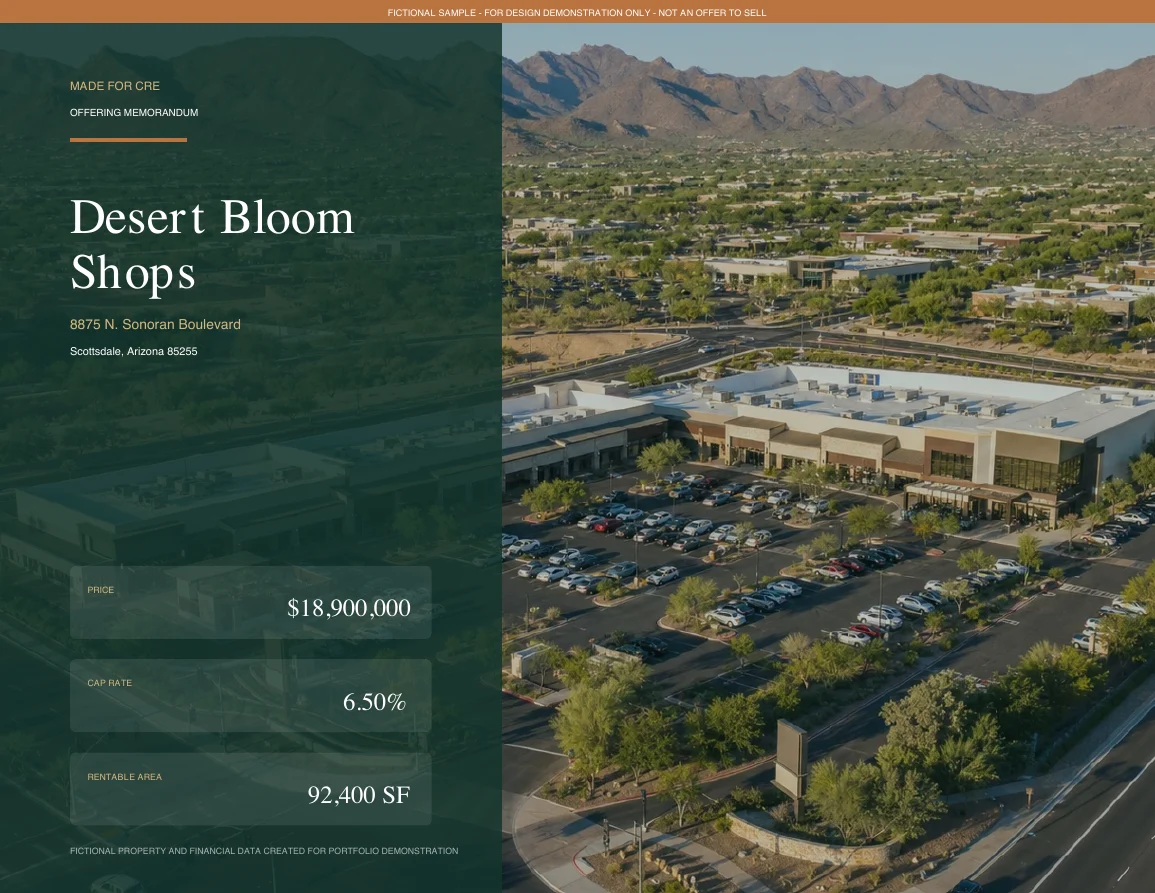
Photography should reveal condition, access, tenancy, surrounding context, and physical quality. Prioritize a concise set of strong images over a gallery of near-duplicates. Label conceptual renderings, proposed improvements, and altered images clearly.
Aerials are especially useful when they are annotated with restraint. Too many arrows, logos, and labels create noise; too few waste the perspective. Every callout should support the investment thesis.
Finish with a controlled production process
The final review should cover more than spelling. Reconcile financial figures, dates, unit counts, addresses, tenant names, broker licenses, source notes, and disclosures across the OM and every related campaign asset.
- Use a single approved source for each critical fact.
- Run a dedicated financial and legal-content review separate from design proofing.
- Check the PDF at full screen, on a laptop, and on a phone.
- Confirm file size, bookmarks, links, accessibility basics, and print behavior.
The best OM feels effortless to read because the hard decisions about hierarchy, evidence, and consistency were made before delivery.
Ideas for your next website or property campaign?
We would be glad to help you bring them to life.


Good work starts with a conversation
Your firm deserves a website that fits.
Custom design for the people, properties, and expertise that make your brokerage yours.